 Blinkers Flip 2g
 Buzz Bar 2g
 The Smoothie Bar
SUPERHIGH x Runtz: Why American-Inspired Dual-Chamber Hardware Is Becoming a Stronger B2B Trend

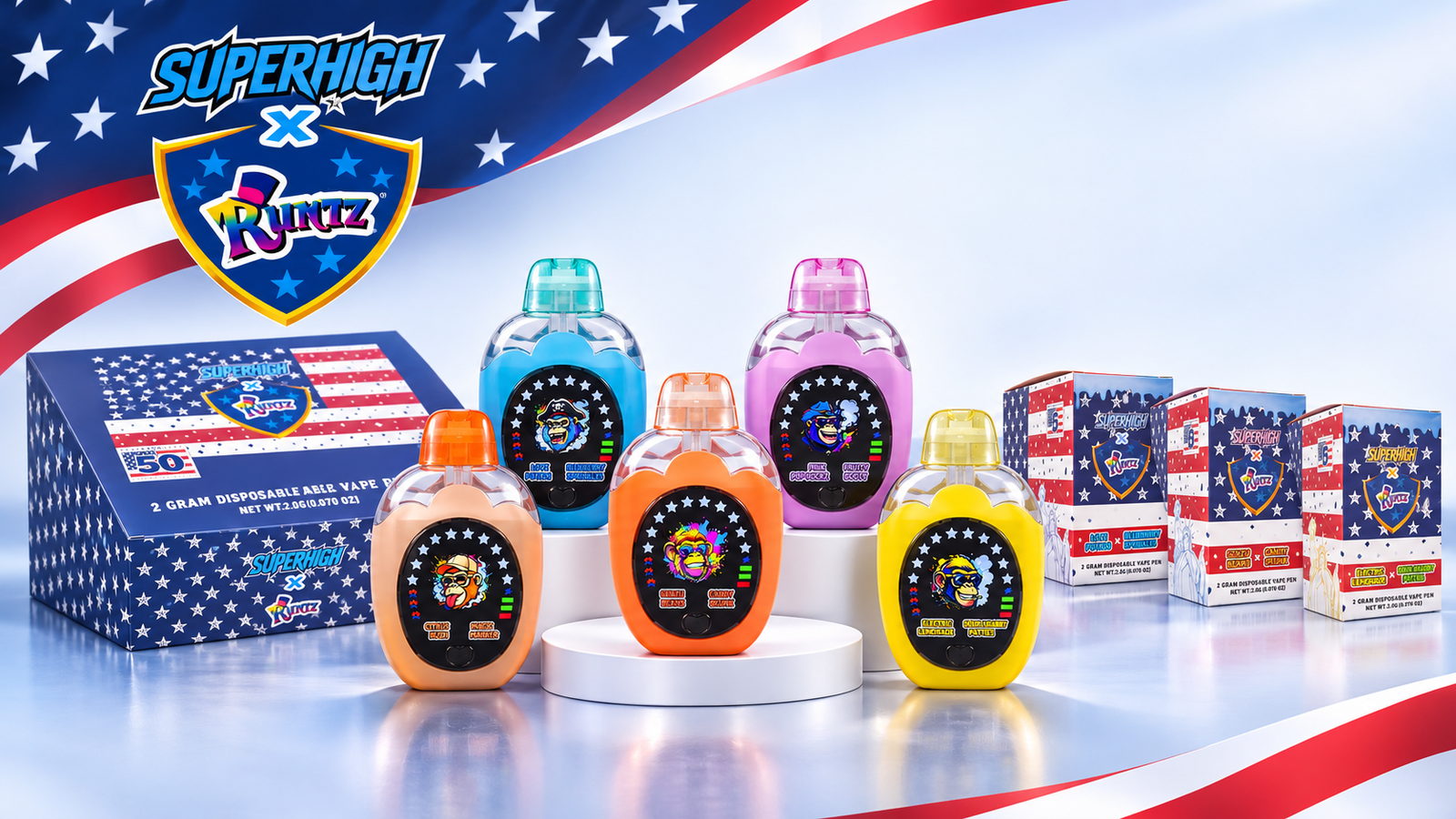
SUPERHIGH x Runtz The modern all-in-one hardware market is becoming increasingly visual. Capacity still matters, but buyers are no longer evaluating products only by how many grams a device can hold. Branding, interface design, SKU organization, packaging structure, and hardware architecture are becoming equally important.
The SUPERHIGH x Runtz concept is a useful example of this shift.
The collection combines an American-inspired visual identity with a 2G dual-chamber format, a large digital front interface, transparent upper housing, multiple color variants, and coordinated retail packaging. Rather than functioning as a simple device with a logo added to the front, the complete system is designed to look like one recognizable product family.
For B2B buyers, this offers an opportunity to examine a wider question: why are collaboration-style branding, dual-reservoir hardware, and digital interfaces appearing together so frequently in newer product development?
SUPERHIGH x Runtz Is More Than a Capacity Story
A conventional hardware listing often begins and ends with capacity.
A 2G device is described as 2G, a larger number is treated as an upgrade, and the product story stops there.
SUPERHIGH x Runtz takes a different direction.
The visual identity suggests a “Super Pure Runtz” style concept built around bold graphics, colorful characters, shield branding, and an unmistakably American-inspired presentation.
This matters because products increasingly compete at the level of recognition.
When wholesalers show dozens of similarly shaped devices in one catalog, specifications alone may not create enough distinction. A recognizable visual system gives the buyer another reason to remember a particular series.
That does not mean branding replaces hardware quality. It means branding and engineering increasingly need to support each other.
Why American Flag Design Creates Immediate Recognition-SUPERHIGH x Runtz
The most obvious visual theme is the use of American flag elements.
Stars, red-and-white stripes, navy blue backgrounds, and shield-style graphics appear repeatedly across the individual boxes and master carton.
From a merchandising perspective, these elements communicate a U.S.-oriented identity extremely quickly.
A shopper does not need to read several paragraphs to understand the visual direction.
For a B2B buyer, this creates a useful display advantage because the packaging can stand out against products that rely on generic metallic gradients or abstract patterns.
However, there is an important distinction between American-inspired design and a formal Made in USA claim.
The Federal Trade Commission explains that unqualified “Made in USA” claims generally require a product to be all or virtually all made in the United States. Visual elements such as flags, maps, or other U.S. references can also contribute to the overall impression created by an advertisement.
That makes origin language especially important for products using patriotic graphics.
A product can use an American-inspired visual identity without claiming that it was manufactured in the United States.FTC – Complying with the Made in USA Standard
SUPERHIGH x Runtz Dual-Chamber Hardware Is Becoming a Bigger Part of Product Differentiation
The next important trend is the move from one reservoir to two.
A traditional 2G device may place the entire nominal capacity into one chamber.
A dual-chamber platform instead organizes the capacity across two separately presented reservoir sections, often described as a 1G + 1G architecture.
Why does this matter?
Because dual chambers introduce choice.
A single large reservoir mainly changes how much material the hardware can hold. Two chambers change how the product can be organized, labeled, switched, and merchandised.
For suppliers, one standardized device platform can support numerous paired configurations without requiring a completely different mold for each SKU.
That potentially makes it easier to build:
- paired SKU collections;
- coordinated color variants;
- standardized packaging dimensions;
- consistent product photography;
- broader wholesale assortments.
SUPERHIGH x Runtz The Screen Is Becoming Part of Brand Identity
Digital displays were originally treated mainly as status indicators.
Today, that role is expanding.
On products such as SUPERHIGH x Runtz, the screen is one of the most visually dominant areas of the entire device.
The large black display panel provides room for two channel names, status graphics, color indicators, and character artwork.
This means the interface is doing two jobs simultaneously.
It communicates operating information while also carrying the visual identity of the SKU.
That is an important shift.
Once the display becomes part of the branding system, firmware design, screen graphics, and hardware functionality can no longer be treated as completely separate decisions.
A sourcing team should ask not only:
Does the screen turn on?
It should also ask:
What does each indicator represent?
Does channel selection correspond correctly with the display?
Are battery or status values measured directly or estimated by firmware?
Does the screen behavior remain consistent across production batches?
SUPERHIGH x Runtz Color-Coded SKUs Help Build a Collection
The SUPERHIGH x Runtz assortment shown in the images includes orange, blue, purple, mint, red, yellow, pink, turquoise, and other color treatments.
This gives the collection visual diversity without changing the overall device architecture.
That can be commercially useful.
A distributor can photograph ten SKUs together and immediately create the impression of a broad assortment while still working with one recognizable hardware family.
But color coding should never become the only warehouse identification method.
As the assortment grows, formal product identification becomes increasingly important.
GS1 explains that GTINs can be encoded in retail and logistics barcodes, while formats such as GS1-128, GS1 DataMatrix, and GS1 QR can also carry information such as batch data.
For a multi-SKU collection, that provides a far more reliable inventory structure than remembering that “yellow means one pair and purple means another.”
SUPERHIGH x Runtz Packaging Can Turn Hardware Into a Retail System
Packaging is another reason SUPERHIGH x Runtz works better as a blog case study than as a simple hardware listing.
The individual cartons and master box share the same American-inspired design system.
Stars, stripes, shield graphics, logo placement, and product colors all reinforce one another.
This creates what can be described as a retail system.
The device is one layer.
The individual package is another.
The master carton becomes the final layer.
For B2B customers, this helps create consistency across photographs, catalogs, warehouse organization, and reseller presentations.
A collection is easier to understand when all of those layers speak the same visual language.
SUPERHIGH x Runtz Why Traceability Matters More as SKU Counts Increase
The more variants a product family includes, the more important traceability becomes.
If several batches contain different color shells, paired selections, screen graphics, or packaging revisions, a distributor needs a way to identify which production version reached which customer.
This is where supply-chain documentation becomes part of product quality.
NIST’s 2026 Supply Chain Traceability Meta-Framework emphasizes verifiable provenance and the ability to organize and link supply-chain data across different organizations and geographic locations.
For a B2B hardware program, the practical lesson is simple:
good branding should be supported by good records.
Useful records can include:
- batch numbers;
- production dates;
- packaging revision;
- hardware revision;
- battery revision;
- QC results;
- shipment identifiers.
This is especially useful when repeat orders are placed months apart.
Final Perspective
SUPERHIGH x Runtz illustrates a broader change in the all-in-one hardware market.
Products are no longer competing through capacity alone.
A successful modern platform may combine:
hardware architecture, digital interaction, visual identity, SKU differentiation, packaging, and supply-chain organization.
The American flag design gives the collection immediate recognition.
The dual-chamber architecture gives it a functional point of differentiation.
The digital display creates an interactive branding surface.
The multi-color collection supports stronger merchandising.
And formal traceability helps turn those visual advantages into a more manageable B2B product program.
For wholesalers and hardware buyers, that combination is more important than any single feature.
The strongest products are increasingly those that can be understood as complete systems—from the internal reservoir architecture all the way to the master carton.