
 Blinkers Flip 2g
 Buzz Bar 2g
 The Smoothie Bar
1G vs 2G vs 3G Vape Empty Disposable Hardware

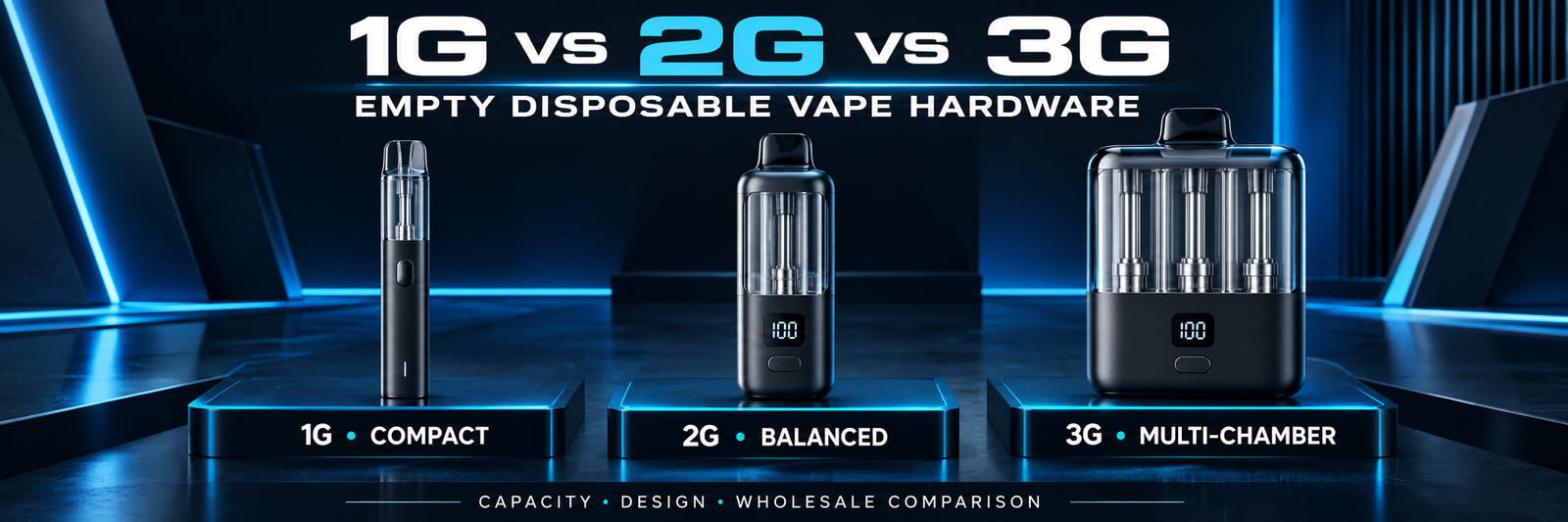
1G vs 2G vs 3G Vape empty disposable vape hardware, including capacity definitions, battery design, chamber layouts, testing, packaging and wholesale planning.
Capacity labels need context-1G vs 2G vs 3G Vape
The labels 1G disposable vape, 2G Disposable Vape and 3G Disposable Vape are useful search terms, but they do not fully describe an empty device. Depending on the supplier and intended formulation, the label may refer to a nominal reservoir volume, an intended fill mass or the combined capacity of multiple chambers. Density means grams and milliliters are not universally interchangeable. A professional specification should state the measurement basis, number of chambers, per-chamber capacity, recommended fill level and tolerance. Marketing copy should repeat the verified specification rather than infer it from a model name.
What a 1G platform offers-1G vs 2G vs 3G Vape
A 1G format can support a compact body, lower material usage and a focused single-reservoir design. It may be appropriate for sampling, limited releases or formulations that benefit from a smaller package. Smaller does not mean that validation can be reduced: inlet geometry, headspace and battery matching still need testing. Buyers should review device dimensions and actual usable capacity because two 1G platforms can differ substantially in reservoir shape and filling method.
Understanding 2G formats-1G vs 2G vs 3G Vape
The 2G category includes several architectures. One device may contain a single nominal 2G reservoir; another may combine two 1G chambers. AIOVAPEPRO’s current catalog illustrates this difference across single-chamber, dual-chamber and screen-equipped models. For sourcing, specify whether the project requires one formulation, two isolated formulations or selectable sides. That choice influences the heating system, controls, packaging claims and quality plan. Do not merge these formats into one comparison based only on total capacity.
Why 3G often means more complexity-1G vs 2G vs 3G Vape
A larger nominal capacity can require a larger reservoir, a different battery strategy or multiple tanks. AIOVAPEPRO lists a 3G triple-tank example described as 1G plus 1G plus 1G. Multi-reservoir construction creates more seals, liquid paths and electrical connections to evaluate. It also creates more information that must fit on packaging. Before choosing a 3G platform, confirm whether the added capacity serves the target product or simply increases size and validation burden.
Battery capacity is not a runtime guarantee-1G vs 2G vs 3G Vape
It is tempting to match larger reservoirs with a larger milliamp-hour number and assume proportional runtime. Actual performance depends on cell quality, power delivery, coil resistance, cutoff settings, charging behavior, storage and user patterns. Compare complete electrical specifications and test devices through a defined usage cycle. Ask for the UN 38.3 test summary applicable to the cell or battery and consult current IATA requirements for air shipment. These records concern transport; they should not be presented as proof of formulation safety or consumer health effects.
Packaging and logistics scale with the device-1G vs 2G vs 3G Vape
Increasing device size can reduce the number of units per inner carton or master case and can change chargeable shipping volume. Compare individual-box dimensions, gross weight, units per carton and pallet efficiency. Rechargeable devices containing lithium cells also require correct classification, documentation and carrier acceptance. IATA updates its Dangerous Goods Regulations and battery guidance, so a shipping method used for an earlier model may not automatically apply to a new configuration.
Build a fair comparison matrix-1G vs 2G vs 3G Vape
Evaluate each candidate on verified capacity, chamber count, device dimensions, cell specification, charging interface, heater configuration, fill method, seal method, packaging quantity and target-market documentation. Add sample results for leakage, output, charging, storage and drop testing. Use the same formulation and procedure for all candidates. A consistent matrix prevents a visually impressive screen or larger headline number from outweighing more important evidence.
Choose capacity after defining the use case-1G vs 2G vs 3G Vape
Select 1G when compactness and a focused formulation are priorities; select 2G when the project needs more nominal capacity or a dual 1G architecture; consider 3G when the added capacity or multi-chamber concept has been validated as a real benefit. Start with the appropriate AIOVAPEPRO capacity category, then verify the exact device specification in writing. Market rules may restrict certain capacities, ingredients, devices or disposal methods, so destination review must occur before packaging and purchase.
Questions to send with the request for quotation
A detailed request produces a more useful quotation and makes supplier comparisons easier. Include the project market, estimated quantity, intended schedule and answers required in writing. For this topic, ask:
- Is capacity stated as volume, fill mass or a nominal family name?
- How many reservoirs are used and what is each recommended fill?
- What device and carton dimensions apply to each capacity option?
- Which battery configuration is paired with the selected heater system?
- How does the larger format change sampling and leakage testing?
- Are current transport records available for the exact battery configuration?
Review the answers against drawings, samples and model-specific records. If a material specification or document remains unavailable, record the gap and decide whether additional testing, a contract condition or another platform is required before approval. This step turns the article topic into a practical sourcing workflow and gives the buyer evidence that can be retained for repeat orders.